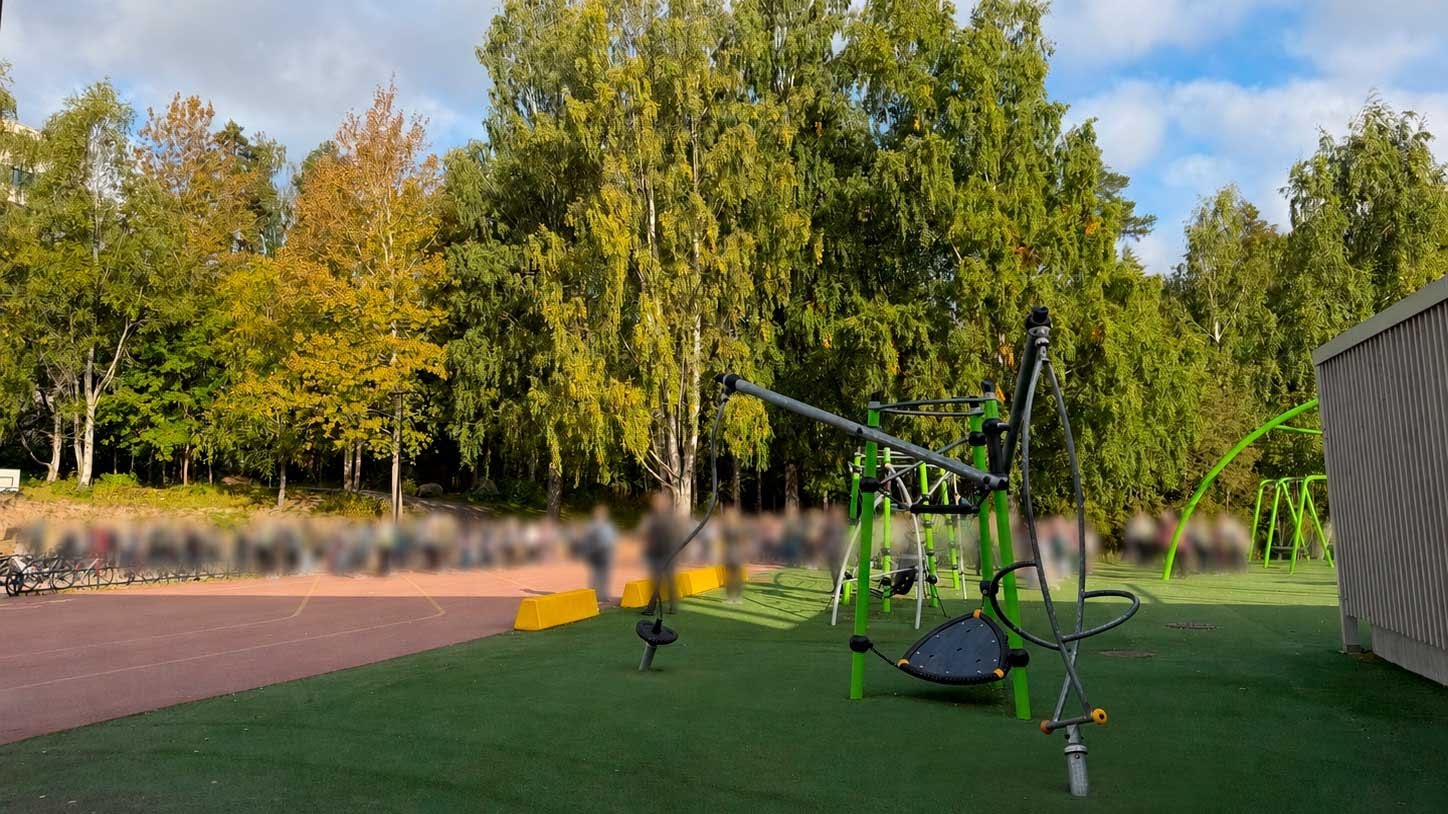
Photo: Secapp. AI was used to blur people in the photograph.
On 3 September 2026, Kortepohja Daycare School in Jyväskylä practised a scenario in which the building’s main water pipe had broken and activities could no longer continue on the premises. Approximately 500 children and 100 staff members were relocated to Gradia’s Viitaniemi campus as an emergency measure.
Secapp was used in the PaPu exercise to send alerts and instructions, track acknowledgements and enable communication among the organisations involved. What made the exercise particularly notable was that Kortepohja Daycare School had introduced Secapp only about a week earlier.
The timing coincided with Mighty Stronghold 26, a local defence exercise led by the Finnish Defence Forces in Central Finland. Although the two exercises took place at the same time, Kortepohja Daycare School’s PaPu exercise was not officially part of Mighty Stronghold 26. Its objectives and scenario were based on the school’s own emergency plan and preparedness needs. Mighty Stronghold 26 took place at several locations from 29 August to 4 September 2026.
The exercise put the emergency plan to the test
Emergency relocation means urgently moving people to a nearby place of safety for a short period, for example because of a fire, an accident or an imminent threat. It can take place in both normal and exceptional circumstances.
In Kortepohja Daycare School’s exercise scenario, a main water pipe in the building had broken, making it impossible to continue activities on the premises. The school’s emergency plan designated Gradia’s Viitaniemi campus as the relocation site in such a situation.
For the first time at this scale, the exercise tested how the plan works in practice: how a large group of adults and children can move safely to another building, how the receiving institution accommodates them, how everyday activities resume at the temporary site and how the different organisations work together.
According to Päivi Liimatainen, Principal of Kortepohja Daycare School, an operation of this scale cannot be assessed reliably on the basis of plans alone.
“Real exercises are where we learn. A plan on paper cannot give us the same experience with an exercise of this scale. Now we have seen in practice that an emergency relocation can be carried out,” Liimatainen says.
Liimatainen and Timo Korhonen, Head of the Daycare Centre, led the preparation and management of the exercise. Kortepohja Daycare School and Gradia carried out the relocation. Observers included representatives of student welfare services, healthcare, the City of Jyväskylä, SOL, RTK, Secapp and the Wellbeing Services County of Central Finland, as well as a school social worker.
According to Gradia’s advance announcement, approximately 500 pupils and staff members from the daycare school arrived at the Viitaniemi campus during the exercise.
How the exercise unfolded
During the journey, it emerged that one of the planned routes had been closed, so the route had to be changed along the way.
On arrival at Gradia, the early childhood education children and staff were directed to one building and the schoolchildren and their staff to another. Teaching and daycare activities then began in the temporary facilities. Field catering was arranged for the schoolchildren, the younger children ate in the dining hall, and the youngest children were given an opportunity to nap.
Parents and guardians received separate instructions for collecting children in early childhood education from the temporary site. Apart from communications with parents and guardians, Secapp was used to communicate the exercise’s progress, the route change and practical arrangements.

Photo: Secapp. AI was used to blur people in the photograph.
Secapp brought exercise communications together
An emergency relocation succeeds when the right people receive information quickly, understand their instructions and can pass current information on to other organisations.
For the exercise, separate Secapp groups had been created for Kortepohja Daycare School’s management and employees and for Gradia’s staff, among others. Secapp was used to send alerts, instructions and updates on the situation and to track recipients’ acknowledgements.
The exercise made particular use of Secapp’s follow-up message feature and group-based alerting. A follow-up message lets users continue communication related to the original alert in the same message thread. One of three priority levels can be selected for a follow-up message, drawing the recipient’s attention with an alert sound appropriate to the situation. Group-based alerting allows different user groups to be set up in Secapp so that the right message reaches the right people.
Kortepohja Daycare School had introduced Secapp only about a week before the exercise. Despite the short time available, the team was able to use its key features extensively. Secapp replaced Signal, which the school had previously used for critical communications.
“We got to grips with Secapp quickly. Being able to use it in such a large exercise after only about a week showed that the system really can be put into use quickly,” Liimatainen says.
Establishing shared practices and broad user proficiency across several organisations naturally takes more time. The exercise nevertheless showed that Secapp can be introduced and its key features put to use quickly.
The exercise revealed areas for improvement
Alongside giving staff practical experience, the exercise aimed to identify what still needed improvement.
During the move from Kortepohja Daycare School to Gradia’s Viitaniemi campus, some employees said they had not heard the sound of a medium-priority Secapp alert. This showed why message priorities, alert sounds and individual notification settings need to be tested in the environment where the system will actually be used.
The alert volume can be adjusted in the Secapp app’s audio settings on a mobile device. The exercise was a reminder to check the settings on every device in advance. It is also useful to test whether alerts are noticed while people are moving and in places where speech, traffic or other sounds may make them harder to hear.
Recipient group names also need to be clear and consistent. Clearly named groups help people send messages quickly and reliably to the right recipients in urgent situations. This is especially important when Secapp is used to alert staff or stakeholders from several organisations.
Use a critical communications tool in everyday work, too
One of the exercise’s main lessons was that a critical communications system should not sit unused while waiting for an incident. If people use it only a few times a year, they may not be sufficiently familiar with it when time is short.
According to Liimatainen, Secapp should be used and tested regularly, for example in staff briefings and smaller tabletop exercises. This builds routine and makes it easier to use the system when needed.
In addition to communications during major disruptions and emergencies, Kortepohja Daycare School will use Secapp’s OneClick buttons for purposes such as staff requests for assistance and discreet searches.
Exercises also strengthen psychological safety
The emergency relocation was a major undertaking for the whole daycare school community. It required children and staff to act differently from their usual routines. The demands of the day had been taken into account both before and after the exercise.
According to Liimatainen, when practising with children, it is important to consider carefully what to practise, how often and in what way. Particular attention is needed for children who may find unfamiliar situations especially stressful. Carrying out the exercise safely and discussing it afterwards with professional support are part of the process.
At the same time, a successful exercise strengthens confidence in one’s own ability and the community’s ability to act. Having experienced what to do in a situation reduces uncertainty.
“Resilience and psychological safety can only grow through practice. Without experience, we cannot learn operational skills or how to work together. During an exercise, we are outside our comfort zone, exactly where we need to be to learn something new,” Liimatainen sums up.
Careful planning and cooperation showed throughout the day
Secapp’s Marketing Manager **Anna-Mari Blek** observed the exercise throughout the day. In her view, its smooth progress showed how much time had gone into planning and cooperation among the organisations involved.
“It was a great experience to observe an exercise of this scale. Throughout the day, it was clear that the exercise had been carefully planned together and that considerable effort had gone into the preparations. The positive team spirit and cooperation were evident all day,” Blek says.
Blek found it particularly significant that communication through Secapp worked well even though Kortepohja Daycare School had used the system for only a short time.
“It was good to see how well Secapp supported communication during the exercise despite the team’s limited experience with it. The exercise also identified ways to improve both the procedures and the use of the system. These findings give us a good basis for continuing our cooperation and building stronger coordination between organisations,” Blek says.
The value of an exercise lies in testing procedures in practice, identifying what needs improvement and incorporating the lessons into preparedness. This strengthens organisations’ ability to act before a real disruption occurs.
Five tips for educational institutions planning an emergency relocation exercise
1. Base the exercise on your emergency plan
Define a specific situation in which activities cannot continue in your own building. Decide in advance where children, students and staff will go and how activities can resume at the temporary site.
2. Involve the receiving organisation and other partners early
An emergency relocation involves more than the organisation leaving its premises. Agree on roles, responsibilities and information flow with the receiving site, student welfare and healthcare services, property services and other key parties.
3. Plan and test Secapp communications before the exercise
Set up the necessary recipient groups, name them clearly and prepare the most important alert and message templates. Agree who will send messages, who will track acknowledgements and what to do if acknowledgements are missing.
4. Test devices and settings in realistic conditions
Check app permissions, alert sounds, volume and notification settings on all devices to be used. Test whether messages are noticed while walking, outdoors and in noisy surroundings, not only at a desk.
5. Consider the demands of the exercise and discuss the experience afterwards
Design the exercise around the needs of children and other participants. Allow time for feedback and a shared review afterwards. Record observations, decide on corrective actions and continue practising regularly.
Kortepohja Daycare School
Kortepohja Daycare School provides early childhood education and primary education in Jyväskylä. It began operating in the Kortetalo building in August 2022.
- The daycare school has approximately 550 children and pupils and about 100 employees.
- Early childhood education is provided for children aged 0–6 in four units and 11 groups.
- Primary education is provided for grades 1–6. The building also hosts preparatory education and flexible support groups.
- About half of the staff work in early childhood education and half in primary education.
- In addition to the daycare school, Kortetalo houses a library, wellbeing and sports services, an adult education centre and a music institute.
Secapp
Secapp is a Finnish platform for critical communications, alerting and documentation. It helps organisations reach the right people quickly, share instructions, track acknowledgements and maintain situational awareness during disruptions and emergencies.
- More than 1,000 organisations and 150,000 professionals use Secapp.
- More than 10 million alerts are sent through Secapp each year.
- Customers include wellbeing services counties and healthcare providers, manufacturing companies, critical infrastructure operators, public authorities, security organisations and educational institutions.
- Secapp employs 49 people.
- The company is headquartered in Jyväskylä.
- Information security management for Secapp’s SaaS platform is certified to ISO/IEC 27001:2022.
Photo: Secapp. AI was used to blur people in the photograph.
On 3 September 2026, Kortepohja Daycare School in Jyväskylä practised a scenario in which the building’s main water pipe had broken and activities could no longer continue on the premises. Approximately 500 children and 100 staff members were relocated to Gradia’s Viitaniemi campus as an emergency measure.
Secapp was used in the PaPu exercise to send alerts and instructions, track acknowledgements and enable communication among the organisations involved. What made the exercise particularly notable was that Kortepohja Daycare School had introduced Secapp only about a week earlier.
The timing coincided with Mighty Stronghold 26, a local defence exercise led by the Finnish Defence Forces in Central Finland. Although the two exercises took place at the same time, Kortepohja Daycare School’s PaPu exercise was not officially part of Mighty Stronghold 26. Its objectives and scenario were based on the school’s own emergency plan and preparedness needs. Mighty Stronghold 26 took place at several locations from 29 August to 4 September 2026.
The exercise put the emergency plan to the test
Emergency relocation means urgently moving people to a nearby place of safety for a short period, for example because of a fire, an accident or an imminent threat. It can take place in both normal and exceptional circumstances.
In Kortepohja Daycare School’s exercise scenario, a main water pipe in the building had broken, making it impossible to continue activities on the premises. The school’s emergency plan designated Gradia’s Viitaniemi campus as the relocation site in such a situation.
For the first time at this scale, the exercise tested how the plan works in practice: how a large group of adults and children can move safely to another building, how the receiving institution accommodates them, how everyday activities resume at the temporary site and how the different organisations work together.
According to Päivi Liimatainen, Principal of Kortepohja Daycare School, an operation of this scale cannot be assessed reliably on the basis of plans alone.
“Real exercises are where we learn. A plan on paper cannot give us the same experience with an exercise of this scale. Now we have seen in practice that an emergency relocation can be carried out,” Liimatainen says.
Liimatainen and Timo Korhonen, Head of the Daycare Centre, led the preparation and management of the exercise. Kortepohja Daycare School and Gradia carried out the relocation. Observers included representatives of student welfare services, healthcare, the City of Jyväskylä, SOL, RTK, Secapp and the Wellbeing Services County of Central Finland, as well as a school social worker.
According to Gradia’s advance announcement, approximately 500 pupils and staff members from the daycare school arrived at the Viitaniemi campus during the exercise.
How the exercise unfolded
During the journey, it emerged that one of the planned routes had been closed, so the route had to be changed along the way.
On arrival at Gradia, the early childhood education children and staff were directed to one building and the schoolchildren and their staff to another. Teaching and daycare activities then began in the temporary facilities. Field catering was arranged for the schoolchildren, the younger children ate in the dining hall, and the youngest children were given an opportunity to nap.
Parents and guardians received separate instructions for collecting children in early childhood education from the temporary site. Apart from communications with parents and guardians, Secapp was used to communicate the exercise’s progress, the route change and practical arrangements.
Photo: Secapp. AI was used to blur people in the photograph.
Secapp brought exercise communications together
An emergency relocation succeeds when the right people receive information quickly, understand their instructions and can pass current information on to other organisations.
For the exercise, separate Secapp groups had been created for Kortepohja Daycare School’s management and employees and for Gradia’s staff, among others. Secapp was used to send alerts, instructions and updates on the situation and to track recipients’ acknowledgements.
The exercise made particular use of Secapp’s follow-up message feature and group-based alerting. A follow-up message lets users continue communication related to the original alert in the same message thread. One of three priority levels can be selected for a follow-up message, drawing the recipient’s attention with an alert sound appropriate to the situation. Group-based alerting allows different user groups to be set up in Secapp so that the right message reaches the right people.
Kortepohja Daycare School had introduced Secapp only about a week before the exercise. Despite the short time available, the team was able to use its key features extensively. Secapp replaced Signal, which the school had previously used for critical communications.
“We got to grips with Secapp quickly. Being able to use it in such a large exercise after only about a week showed that the system really can be put into use quickly,” Liimatainen says.
Establishing shared practices and broad user proficiency across several organisations naturally takes more time. The exercise nevertheless showed that Secapp can be introduced and its key features put to use quickly.
The exercise revealed areas for improvement
Alongside giving staff practical experience, the exercise aimed to identify what still needed improvement.
During the move from Kortepohja Daycare School to Gradia’s Viitaniemi campus, some employees said they had not heard the sound of a medium-priority Secapp alert. This showed why message priorities, alert sounds and individual notification settings need to be tested in the environment where the system will actually be used.
The alert volume can be adjusted in the Secapp app’s audio settings on a mobile device. The exercise was a reminder to check the settings on every device in advance. It is also useful to test whether alerts are noticed while people are moving and in places where speech, traffic or other sounds may make them harder to hear.
Recipient group names also need to be clear and consistent. Clearly named groups help people send messages quickly and reliably to the right recipients in urgent situations. This is especially important when Secapp is used to alert staff or stakeholders from several organisations.
Use a critical communications tool in everyday work, too
One of the exercise’s main lessons was that a critical communications system should not sit unused while waiting for an incident. If people use it only a few times a year, they may not be sufficiently familiar with it when time is short.
According to Liimatainen, Secapp should be used and tested regularly, for example in staff briefings and smaller tabletop exercises. This builds routine and makes it easier to use the system when needed.
In addition to communications during major disruptions and emergencies, Kortepohja Daycare School will use Secapp’s OneClick buttons for purposes such as staff requests for assistance and discreet searches.
Exercises also strengthen psychological safety
The emergency relocation was a major undertaking for the whole daycare school community. It required children and staff to act differently from their usual routines. The demands of the day had been taken into account both before and after the exercise.
According to Liimatainen, when practising with children, it is important to consider carefully what to practise, how often and in what way. Particular attention is needed for children who may find unfamiliar situations especially stressful. Carrying out the exercise safely and discussing it afterwards with professional support are part of the process.
At the same time, a successful exercise strengthens confidence in one’s own ability and the community’s ability to act. Having experienced what to do in a situation reduces uncertainty.
“Resilience and psychological safety can only grow through practice. Without experience, we cannot learn operational skills or how to work together. During an exercise, we are outside our comfort zone, exactly where we need to be to learn something new,” Liimatainen sums up.
Careful planning and cooperation showed throughout the day
Secapp’s Marketing Manager **Anna-Mari Blek** observed the exercise throughout the day. In her view, its smooth progress showed how much time had gone into planning and cooperation among the organisations involved.
“It was a great experience to observe an exercise of this scale. Throughout the day, it was clear that the exercise had been carefully planned together and that considerable effort had gone into the preparations. The positive team spirit and cooperation were evident all day,” Blek says.
Blek found it particularly significant that communication through Secapp worked well even though Kortepohja Daycare School had used the system for only a short time.
“It was good to see how well Secapp supported communication during the exercise despite the team’s limited experience with it. The exercise also identified ways to improve both the procedures and the use of the system. These findings give us a good basis for continuing our cooperation and building stronger coordination between organisations,” Blek says.
The value of an exercise lies in testing procedures in practice, identifying what needs improvement and incorporating the lessons into preparedness. This strengthens organisations’ ability to act before a real disruption occurs.
Five tips for educational institutions planning an emergency relocation exercise
1. Base the exercise on your emergency plan
Define a specific situation in which activities cannot continue in your own building. Decide in advance where children, students and staff will go and how activities can resume at the temporary site.
2. Involve the receiving organisation and other partners early
An emergency relocation involves more than the organisation leaving its premises. Agree on roles, responsibilities and information flow with the receiving site, student welfare and healthcare services, property services and other key parties.
3. Plan and test Secapp communications before the exercise
Set up the necessary recipient groups, name them clearly and prepare the most important alert and message templates. Agree who will send messages, who will track acknowledgements and what to do if acknowledgements are missing.
4. Test devices and settings in realistic conditions
Check app permissions, alert sounds, volume and notification settings on all devices to be used. Test whether messages are noticed while walking, outdoors and in noisy surroundings, not only at a desk.
5. Consider the demands of the exercise and discuss the experience afterwards
Design the exercise around the needs of children and other participants. Allow time for feedback and a shared review afterwards. Record observations, decide on corrective actions and continue practising regularly.
Kortepohja Daycare School
Kortepohja Daycare School provides early childhood education and primary education in Jyväskylä. It began operating in the Kortetalo building in August 2022.
- The daycare school has approximately 550 children and pupils and about 100 employees.
- Early childhood education is provided for children aged 0–6 in four units and 11 groups.
- Primary education is provided for grades 1–6. The building also hosts preparatory education and flexible support groups.
- About half of the staff work in early childhood education and half in primary education.
- In addition to the daycare school, Kortetalo houses a library, wellbeing and sports services, an adult education centre and a music institute.
Secapp
Secapp is a Finnish platform for critical communications, alerting and documentation. It helps organisations reach the right people quickly, share instructions, track acknowledgements and maintain situational awareness during disruptions and emergencies.
- More than 1,000 organisations and 150,000 professionals use Secapp.
- More than 10 million alerts are sent through Secapp each year.
- Customers include wellbeing services counties and healthcare providers, manufacturing companies, critical infrastructure operators, public authorities, security organisations and educational institutions.
- Secapp employs 49 people.
- The company is headquartered in Jyväskylä.
- Information security management for Secapp’s SaaS platform is certified to ISO/IEC 27001:2022.